Showing posts with label Jayanagar. Show all posts

Tuesday, 14 January 2014

A Rangoli contest

The resident association of LIC Colony, Canara Bank and GH Layout had two days ago organised a Rangoli competition for women.
The event was held at the BMP ground adjacent to the BBMP Office in LIC Colony and which is located just off the beautiful LIC Colony park.
The competition was open for residents of  the LIC Colony, Canara Bank Layout and GH Layout in Jayanagar 3rd Block, Bangalore. This was one among the many contests organised for women. The competition drew several women and the Rangoli was drawn on the concrete floor of the BBMP playground.
As we all know, Rangoli is a daily ritual among Hindu households and it is drawn in front of the house early morning. The Rangoli has religious significance and it is called by different names in different regions and different states of India.
Rangoli is a floor art and it is drawn on festive occasions and in front of Kalyana Mantapas, temples and venues where religious events are being organised. There are several books on Rangoli.
While Rangoli is generally drawn with white chalk powder every day, it is given a hue of colours on festive occasions and in competitions.
Here are some images of the beautifully drawn Rangoli.


Sunday, 12 January 2014

Rayaru in Rangoli


Rangoli is found in front of all Hindu households in India and whichever State or region you go, you can see a variety of rangoli in front of houses, temples, religious institutions such as mathas and Veda Patashalas, Kalyana Mantapas and even in front of  venues hosting social and religious events.
Rangoli is drawn on all auspicious occasions such as marriages, Gruhapravesha and Nishchitarta (engagement ceremony).
The tradition of drawing on the floor or/and in front of houses is called Rangoli. Therefore, it is also called floor art and it is an integral part of an Indian household. Rangoli is called by different names in different regions.
There can be innumerable designs and there are designs for every occasions. In earlier days, Rangoli was created with Hittu which attracted sparrows. Now, they are drawn with white chalk powder and on occasions colours are used.
One of the leading haridasas of Karnataka, Jagannatha Dasa of  Manvi was well-known as Rangoli Dasa as he was an expert at this art. He would draw the image of Hari and other Gods as he sang about them and their glories.
We find different Rangoli designs in front of Raghavendra Swamy Mathas.
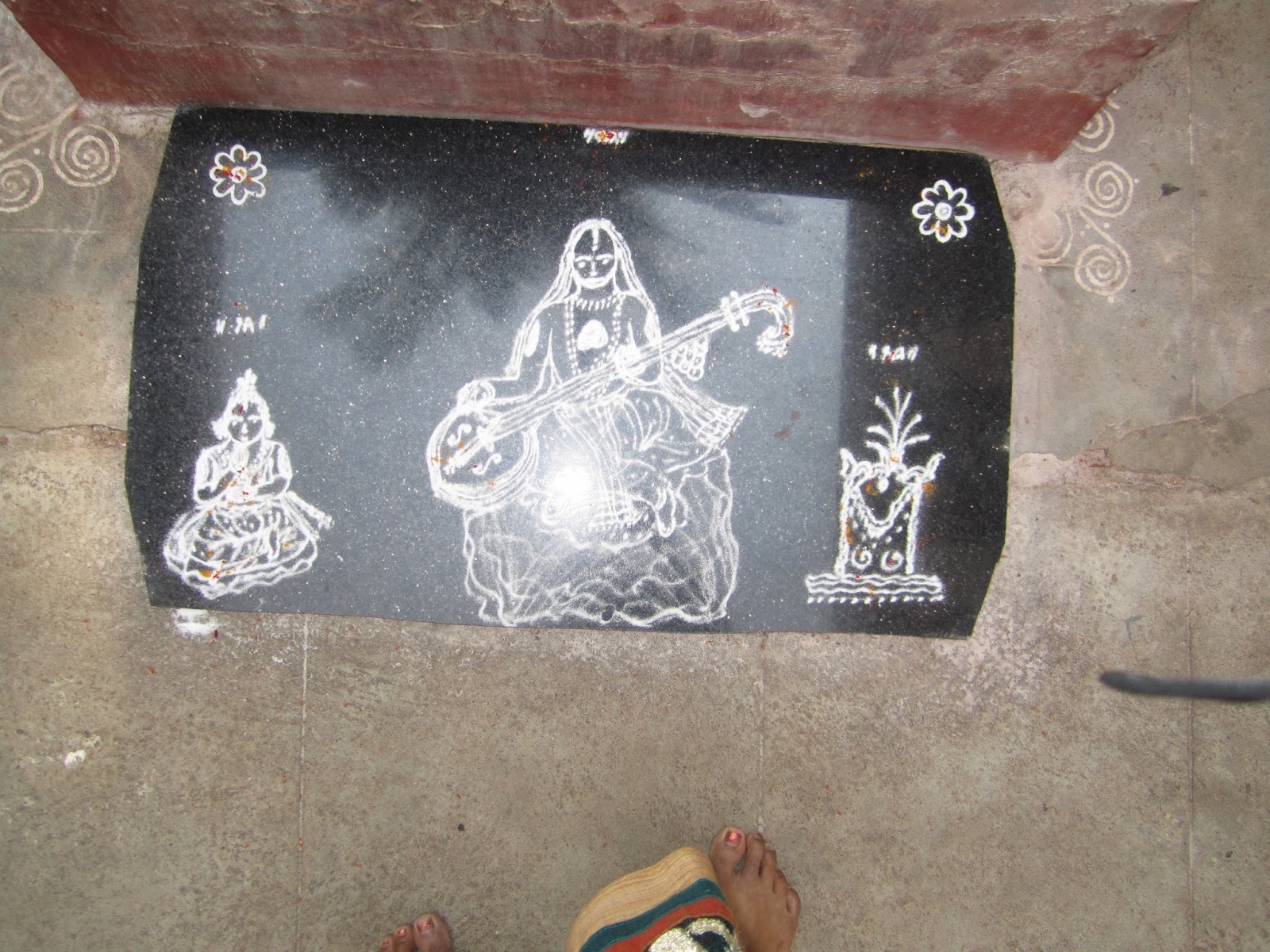
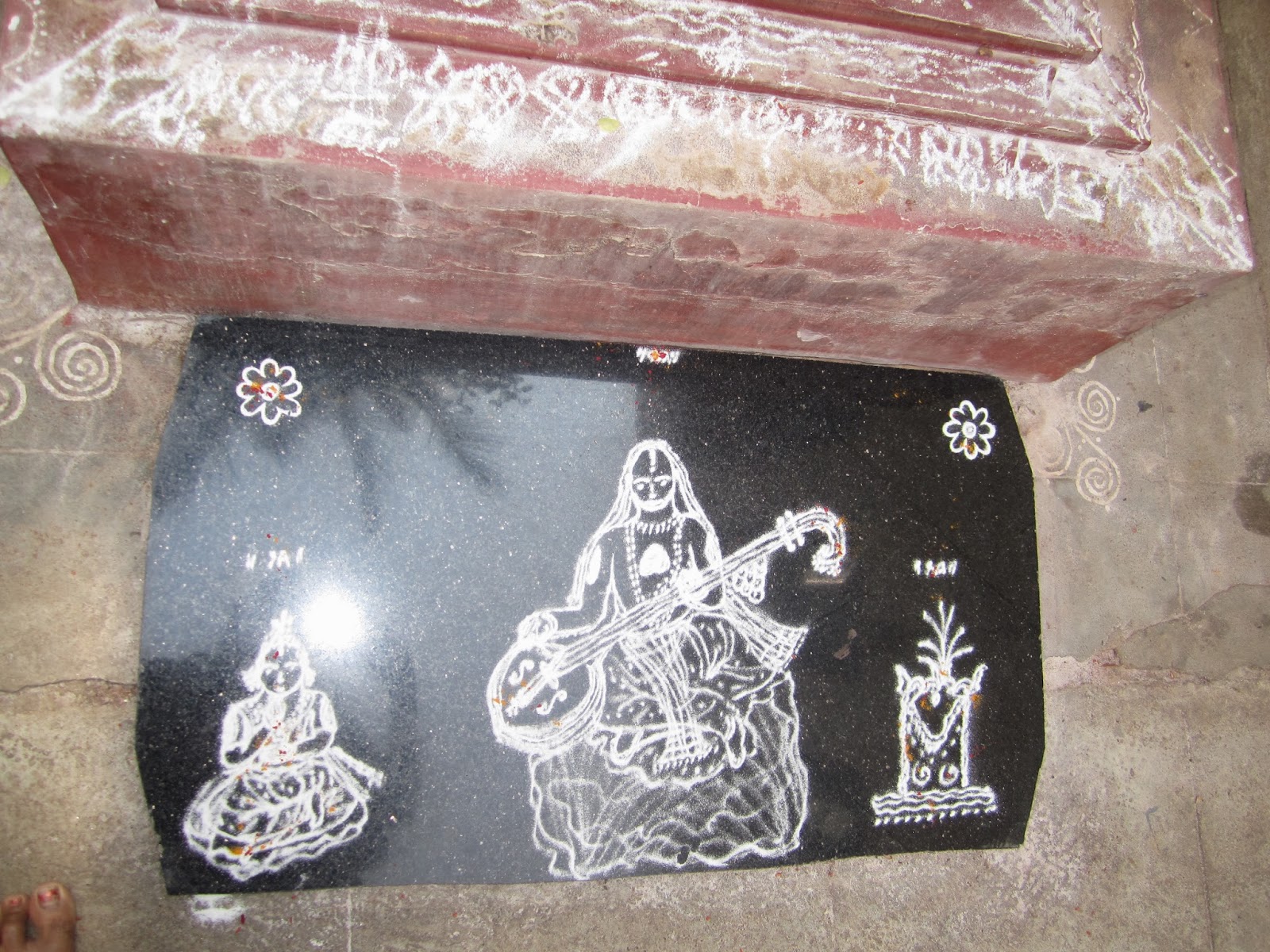
The above image of a Rangoli drawing is from the Raghavendra Swamy Temple in Jayanagar 4th Block. We saw that a woman had drawn a beautiful Rangoli of Rayaru in front of the Tulasi Katte or platform where Tulasi was planted.
The Rangoli shows Rayaru holding the Veena, his favourite musical instrument. Rayaru, like his father Thomanna Bhat, and his grandfather, Kanakachala Bhatta, was an expert Veena player. Both hios grandfather and father were at the court of the Vijayanagar Emperor.
We decided to take a photograph of the Rangoli drawing before it disappeared.

Sunday, 28 April 2013

When a Goddess alighted from an elephant

The Goddess was flying through the sky on her elephant and when she saw a serene and beautiful spot in a thick forest, she came down and took rest. She then took off again, but this time without the elephant as her Savari or  vehicle.
The elephant slowly merged with the surrounding landscape and today there is a huge boulder which bears the painting of an elephant. This painting was one among the many rocks of a small park which has come up at the spot.
The road too is known after the pachyderm and the temple of the Goddess too is almost diagonally opposite the painted elephant. If the elephant rock is on one side of the road, the temple to the Goddess is on the other side of the road.
This is the Ane Bande or Elephant Rock road of Jayanagar, which is an important junction for vehicle coming from South End and proceeding to Jayanagar 3rd Block, Jayanagar 4th Block and the Shopping Complex.
This road is perhaps the only one that can be described as an ode to an elephant.
According to legend, Goddess Patalamma, one of the four local deities of Bangalore, was astride her elephant and passing through the sky when she saw a spot in today’s south Bangalore. She alighted from the elephant and spent some time in the forest and this is the place where the Ane Bande road passes through.
She again took to the skies after some time but she was without her elephant which then dissolved into the rocks. Over time, locals of the area drew the picture of an elephant on the rock and also consecrated the Patalamma Temple across the road.
There is a small temple of Bhavani Shankar adjacent to the elephant rock and several smaller rocks which are believed to be part of an elephant herd. The temple was consecrated by Shantaveera Mahasawmi on November 6, 1994. It was built by a local corporator Bangaramma.  
Today, both Patalamma temple and Ane Bande or Elephant Rock road are inseparables. The Elephant Rock Road begins from the South End Circle and joins the 9th main road, Jayanagar 3rd Block.
When Jayanagar was formed in 1948, some builders wanted to take over the land around the elephant rock. One of the builders employed two engineers to get the rocks removed. The story goes that the engineers died and since then nobody has dared to touch the rocks.
The Patalamma temple a few decades ago was the village deity of five villages around Jayanagar — Nagasandra, Kanakanapalya (area around RV teachers College), Siddapura, Byrasandra and Yediyur. In the early years of the 19th century, it was the deity of  fourteen villages.
The temple is more than 500 to 600 years old. The fire-sacrifice ritual, that is held once in three years, is famous. Devotees throng to the temple on Tuesdays and Fridays.
Within the temple premises are two long pillars with another stone joining them at the top with iron hooks. This is the swing of Goddess Patalamma and she sat on the swing when she alighted from the elephant.  The swing today is used on ceremonial occasions. Close to Patalamma temple is another small temple dedicated to Maha Ganapathi.
At the junction of South End Circle and Elephant Rock Road is the  Southern range of City Central Library. This is one of the oldest libraries in this area and it was established way back in 1969.
Today, very few remember the history of the road and it is slowly being transformed from a totally residential area to a place with business and commerce.
Interestingly, the road that continues after South End circle is called Patalamma Temple Street. This comes under Basavanagudi.

Thursday, 21 February 2013

The politics over a clock

A clock shows us time and the reason why we look at clocks is to ensure that we do not miss appointments or are not delayed. But or politicians are such a breed of people that they rarely go by clock and the word clock wise precision is missing in them.
This was ample demonstrated last Saturday when a host of politicians, including a Deputy Chief Minister, descended on South End in Jayanagar to inaugurate a clock. And ironically, they came one and half hours late and the audience was treated to a full dose of  political talk with a BJP MP even claiming credit for the clock and claiming that it showed development oriented policies of the BJP.
The clock, which the Bruhat Bangalore Mahanagara Palike (BBMP) constructed, was installed at South End in a mini park.
The clock tower is the biggest such structure in Bangalore and it towers over a height of  61 foot. It costed a whooping Rs 90 lakh and the towers is equipped with lights to radiate a different colour each day corresponding to the astrology chart.
Thus, on Monday, it will display white lights; red on Tuesday, green on Wednesday, yellow on Thursday, blue on Friday, dark blue on Saturday and pink on Sunday.
The tower chime, expected to be heard in a two to three km radius, will ring from 6 am to 11 pm. The chime starts with the blowing of a conch shell and is followed by a long and sonorous ring corresponding to the hour.
The BJP MP from Bangalore south, said the clock symbolised the development mantra of the BJP government in Karnataka. Deputy Chief Minister R Ashoka  said the clock tower would become a new landmark of Bangalore South.
The local corporator, Ramesh, declared the clock to be a monument. He claimed that the Information Department had already declared it so. I always though it was the job of the ASI to declare a structure as a monument of importance. Of course, the State Government has the power to preserve and protect a monument but to declare a clock as a monument?   
The Hindu, Bangalore, reported that residents living near South End Circle need not check the clock to read the time. They just have to be all ears and listen to the chimes from the 61-foot clock tower Ambara Chumbana. Well, well, wee. What a goof up. How can I look at a clock to find out the time. I look at a wrist watch and mot a clock. Perhaps the reporter was in a hurry to file the copy and did not understand the difference between a clock and a watch.    
Coming back to the clock tower, it is solar powered and it has three legs and is made of green granite. It also has three faces, each around 8 feet in length. The clock, which has Roman, Arabic and Kannada numerals, chimes for 20 seconds every hour between 6 a.m. and 10 a.m.
A retired general manager of  HMT, Anjanappa, has designed the clock.
He has also designed several other clocks in Bangalore, including the India population clock near Majestic which gives us biological information or rather population status of India. It also gives us the time. The only other similar clock is in Delhi
The floral clock in Lalbagh does not qualify as a clock tower but it is described best by a visitor as a sleeping floral beauty.
There is s clock tower at the BBMP head office on NR Square, the KR market, VV towers and at Raj Bhavan. The solar clock near the GPO wad removed due to ongoing metro work
By the way, there is a small clock tower in Cubbon Park near the Children’s play area. This is a simple clock and it stands on four pillars.  However, Bangalore has always had a tryst with clocks.
Bangalore’s biggest and by far most famous clock came up a few years ago at Omkar Hills in Raja Rajeshwarinagar off Mysore road.
This clock is supposed to bigger than Big Ben of London. Called Bangalore’s Ben, it is a horological wonder and a statistician's delight. It took three years and Rs.20 lakh to build.
It was built by HMT Bangalore and  it has a diameter of 24 ft - a full foot more than Big Ben - and the numerals are 2.5 feet tall. The hour and minute hands of this clock weigh 40 kg each.
The clock tower used up 20 tons of steel with 200 cubic metres of concrete. When the bell strikes every hour, you could be three kilometres away and still hear the sound of a conch followed by a reverberating Om.
The clock was installed to mark the 54th birthday of Shivapuri Swamiji of the Omkar Ashram Mahasamthana.
Some other clock towers in Bangalore are at SJP polytechnic on KR Circle and railway station.   
Amazingly, the resident associations of Jayanagar were not invited to the function. What else can this be called but the politics of a clock sans proper timing.
By the way, this is not the first time that politicians are hogging the limelight for a clock.
Years earlier, a clock tower in Bellary was demolished overnight.
The tower was popularly known as Gadagi Chennappa Clock Tower and it had been built by the Allum family.  
The Allum family has constructed the clock in 1964 in memory of Gadgi Chennappa. It was demolished on June 21, 2008 at the behest of a powerful politician hailing from Bellary.
The clock tower in Bidar is a Bahamani monument and the municipality went ahead and installed the clocks in the monument. It is called Chowbara. They were removed briefly but reappeared. Nobody knows who gave them permission to install a clock in a protected monument.
Mysore has two clock towers-Dodda Gadiyara and Chicka Gadiyara and both are maintained well.
Madikeri fort has a clock tower too and this is a British addition.
Mangalore once had a small but beautiful clock tower. It was pulled down by the municipality 17 years ago. Even today, the area where it once stood is still called Clock Tower. Funnily, the corporation seems to have realised that it was a mistake to pull down the tower and now it wants a clock tower in Gandhi Park. But wait, there is a catch. The corporation wants a drab clock as it does not want the tower to outshine Gandhi. Ha.